
Not all carbon is equal: separating biogenic and fossil emissions in packaging footprints
A tonne of carbon dioxide from burning waste plastic and a tonne released from burning wastepaper tell very different climate stories. However, many carbon footprints add them together as if they were the same. Separating biogenic from fossil carbon is what turns a single number into a defensible, transparent climate claim.
Here is why the biogenic and fossil distinction matters, how PIQET now handles it, and the full family of climate change results available to you.
Why the source of carbon matters
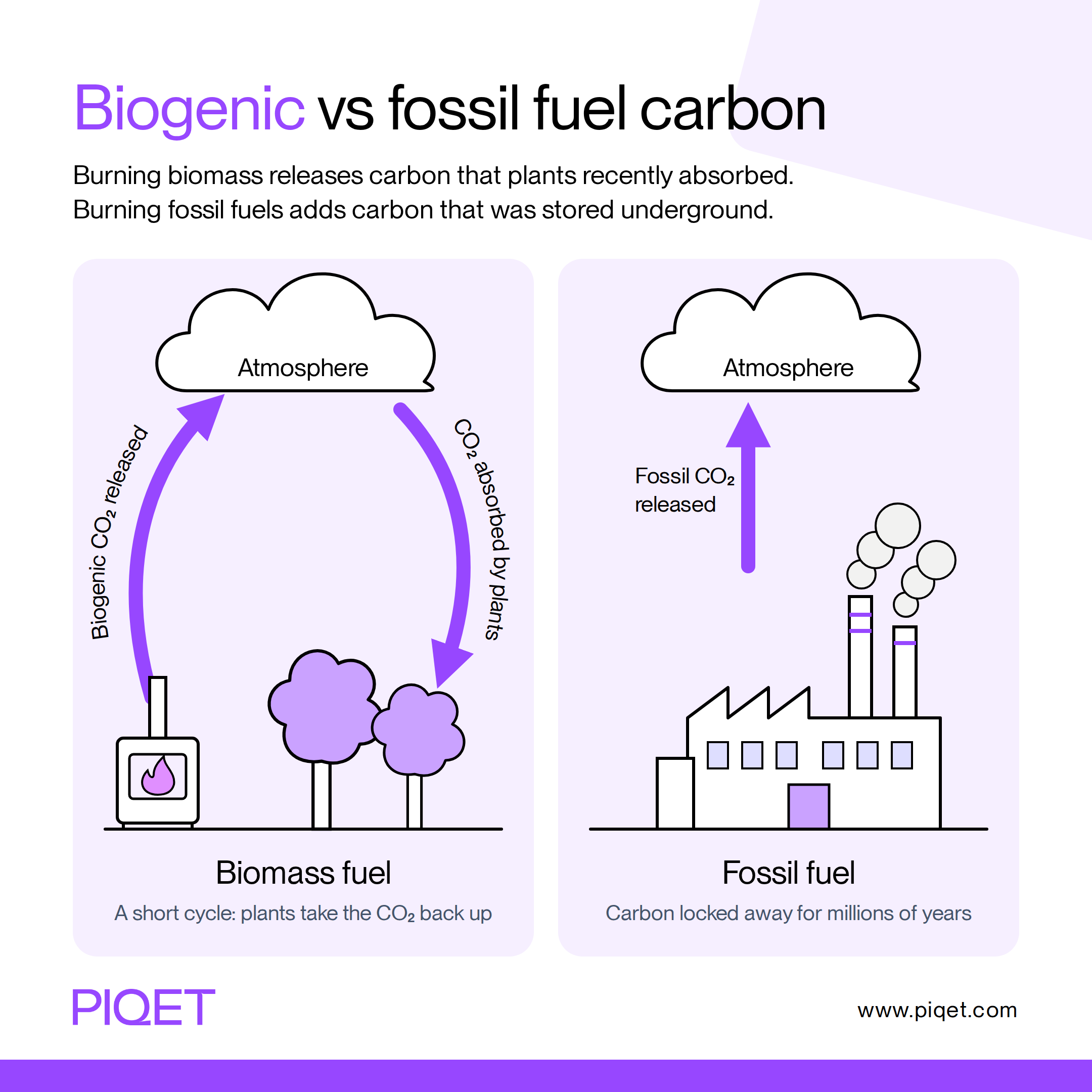
The difference comes down to where the carbon sits in the cycle. Biogenic carbon is part of the short, active carbon cycle: plants absorb carbon dioxide from the atmosphere through photosynthesis during growth, then release it again when the material decomposes or is burned. When it decomposes without oxygen, such as in landfill, some of that carbon is released as methane (CH4) instead, a much more potent greenhouse gas that is counted in the footprint rather than treated as neutral. Because uptake and release broadly balance over time, biogenic carbon dioxide in life cycle assessment (LCA) is often treated as net neutral over the life cycle (Breton et al., 2018).
Fossil carbon behaves differently. It has been locked underground and out of the active cycle for millions of years. When fossil fuels are burned, that carbon is added to the atmosphere as a net new addition. Only some of it is reabsorbed quickly: models indicate that 20 to 35 percent of a fossil carbon dioxide release remains in the atmosphere for centuries, with a long tail persisting for tens of thousands of years (Archer et al., 2009). Two emissions of identical mass, one biogenic and one fossil, therefore have very different long-term climate consequences.
Distinguishing the two is not academic hair-splitting. It improves the accuracy of a footprint, clarifies where genuine reductions can be made, and builds trust in the resulting climate claims.
Why ‘carbon neutral’ biomass is a simplification
A common shortcut is to treat biogenic carbon as automatically ‘carbon neutral’, on the logic that whatever a plant absorbs during growth is released again at end-of-life, netting to zero. It is a reasonable default, and it is the convention PIQET has used to date. But it hides information that packaging teams increasingly need.
Assuming neutrality obscures two things in particular: the carbon physically stored in products sent to landfill, which is not returned to the atmosphere on any near-term horizon, and the timing mismatch between when carbon is absorbed and when it is released. For packaging made from paper, board, and other biobased materials, that stored carbon can be a meaningful part of the story.
How PIQET accounts for carbon
By default, PIQET sets biogenic carbon dioxide emissions and uptakes to zero. This is a deliberate methodological choice: a complete carbon balance across the underlying LCA database tends to produce only small discrepancies, and temporary carbon storage in products and in landfill is excluded in line with the ISO 14067 carbon footprint standard (ISO, 2018). Global warming potential (GWP) factors follow a 100-year time horizon (GWP100), based on IPCC (2021).
What is new: PIQET now offers a ‘Climate change (including biogenic carbon)’ result. Rather than assuming neutrality, it accounts for all carbon flows, both fossil and biogenic. This makes it possible to see the carbon stored in products sent to landfill, and to compare that against the conventional footprint. You keep the trusted default and gain the fuller picture alongside it.
The complete family of climate change results in PIQET
Alongside the headline climate change footprint, PIQET now reports the underlying carbon flows separately, so you can see exactly where impacts arise. It is important to note, the last three results all work together and should not be declared in isolation. For example: if you declare ‘Climate change – fossil’ you should also declare ‘Climate change - biogenic’ and ‘Climate change – land use and land use change’, alongside it - otherwise it only shows a partial result.
Each follows the European Commission’s product environmental footprint (PEF) method (European Commission, 2021), with characterization based on IPCC (2021). The table below summarizes what each result isolates and when to reach for it.
| Climate change result | What it captures and when to use it |
|---|---|
| Climate change | The headline footprint across all greenhouse gases, expressed in kg CO2 eq. (GWP100). Your default for overall reporting and comparison. |
| Climate change - incl. biogenic carbon | Total net emissions integrating fossil and biogenic carbon flows, rather than assuming neutrality. Use to reveal carbon stored in landfilled products. |
| Climate change - fossil | Effects from fossil greenhouse gases only (oxidation, combustion, and landfilling of fossil-based carbon). Use to isolate fossil-driven impacts. |
| Climate change - biogenic | Uptake and emission of biogenic greenhouse gases from biomass. Use to understand the role of biobased materials. |
| Climate change - land use and land use change | Biogenic carbon exchanges from deforestation, soil disturbance, and other land use change. Use where inputs are heavily land-dependent (e.g. forestry and agriculture). |
The takeaway
Separating carbon by its source is what lets you move from a single, hard-to-defend number to a footprint you can explain and stand behind. Fossil reductions, biobased sourcing, and end-of-life storage each show up where they belong. Explore the new ‘Climate change (including biogenic carbon)’ result in your next PIQET assessment and see what your current footprint has been leaving out.
Interested in finding out more? Schedule a demo via the link below.
References
Archer, D., Eby, M., Brovkin, V. et al. (2009) Atmospheric lifetime of fossil fuel carbon dioxide. Annual Review of Earth and Planetary Sciences, 37, pp. 117-134.
Breton, C., Blanchet, P., Amor, B., Beauregard, R. and Chang, W.-S. (2018) Assessing the climate change impacts of biogenic carbon in buildings: a critical review of two main dynamic approaches. Sustainability, 10(6), 2020.
European Commission (2021) Commission Recommendation (EU) 2021/2279 on the use of the Environmental Footprint methods to measure and communicate the life cycle environmental performance of products and organisations. Official Journal of the European Union.
IPCC (2021) Climate Change 2021: The Physical Science Basis. Contribution of Working Group I to the Sixth Assessment Report of the Intergovernmental Panel on Climate Change. Cambridge University Press.
ISO (2018) ISO 14067:2018 Greenhouse gases - Carbon footprint of products - Requirements and guidelines for quantification. International Organization for Standardization.
PIQET (2025) PIQET Indicator Manual v5.1, section 1.2 Climate change. Lifecycles.